


How Wood Pellets Are Made: Inside the Factory of Wood Pellet Vina.
The global shift towards renewable energy has fundamentally transformed how we heat our homes and power our industrial facilities. As the world aggressively moves away from fossil fuels to combat climate change, biomass energy has emerged as a reliable, highly efficient, and sustainable alternative. At the heart of this green energy revolution are wood pellets, a densely compacted form of biomass that offers exceptional heating value and a minimized carbon footprint. Understanding exactly how these tiny cylindrical energy powerhouses are manufactured provides valuable insight into their environmental benefits and combustion efficiency. In this comprehensive guide, we will take you on an exclusive journey behind the scenes to explore the rigorous manufacturing processes that define the industry. We will look specifically at how Wood Pellet Vina operates its state-of-the-art facilities to transform raw forestry byproducts into premium wood pellets. From the initial stages of careful material sourcing to the final steps of quality-controlled packaging, every phase of production requires precise engineering and strict oversight. By examining these advanced industrial techniques, it becomes immediately clear why finding the Best wood pellet supplier is critical for both large-scale industrial buyers and residential consumers. Working with a dedicated wood pellet supplier Vietnam ensures that the final product not only meets but exceeds international standards for energy output, low ash content, and environmental sustainability. Let us step inside the factory and uncover the fascinating engineering and thermodynamic processes that power the future of global renewable energy.
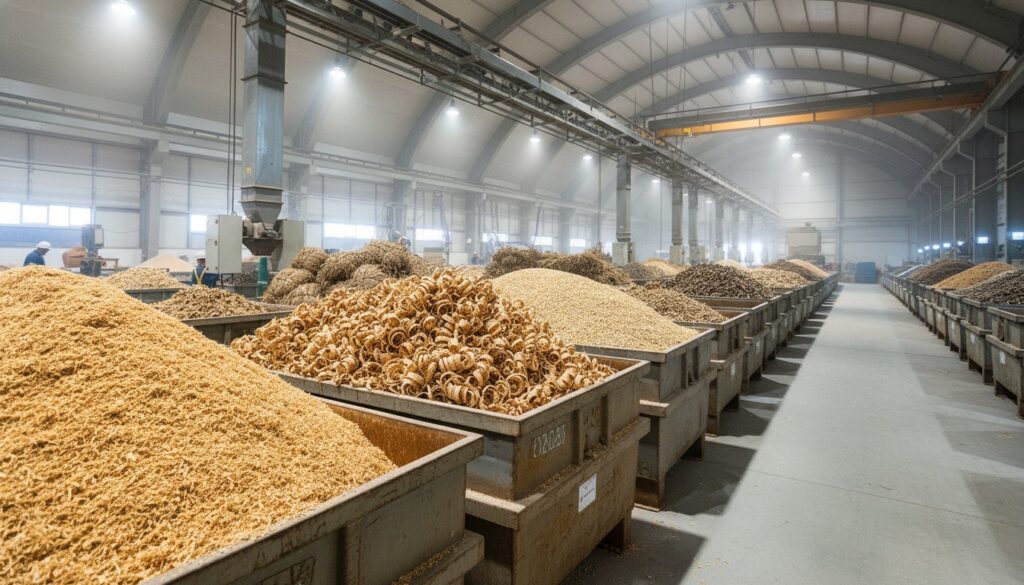
1. Sourcing and Preparing Raw Materials at the Wood Pellet Vina Factory.
The complex journey of manufacturing high-quality biomass fuel begins long before the machinery is even turned on; it starts deep within carefully managed forests and at bustling sawmills. The foundation of any high-performing biomass product relies entirely on the quality and purity of its initial raw materials. At the Wood Pellet Vina factory, the sourcing phase is treated with the utmost importance, as it dictates the energy density, ash content, and overall burning efficiency of the final product. Typically, the primary raw materials consist of wood residues such as sawdust, wood shavings, offcuts, and wood chips that are generated as byproducts from the lumber processing and furniture manufacturing industries. By utilizing these residual materials, the biomass industry plays a crucial role in waste reduction, ensuring that perfectly usable wood fibers do not end up rotting in landfills and releasing harmful methane gas into the atmosphere.
To guarantee the production of truly premium wood pellets, raw materials must be strictly vetted for contaminants. Any introduction of bark, dirt, rocks, or metal fragments can severely degrade the quality of the pellets, leading to higher ash residues during combustion and potentially damaging the sensitive extrusion machinery later in the production line. As a leading wood pellet supplier Vietnam, the facility employs advanced screening technologies to filter out these unwanted impurities. Large vibrating screens and industrial magnetic separators are strategically placed at the intake zones to capture foreign objects. Once the raw material is deemed exceptionally clean, it is often sorted by wood species, as the combination of softwood and hardwood fibers can be adjusted to optimize the lignin content, which acts as a natural binder. The dedication to sourcing pristine, sustainably harvested wood residues is what consistently separates the Best wood pellet supplier from average manufacturers in the competitive global market.
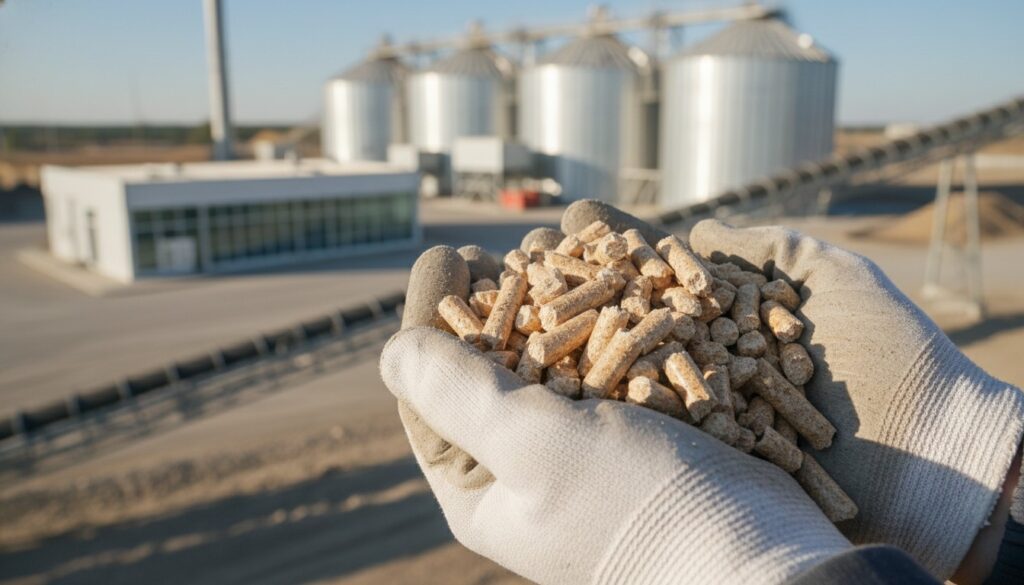
2. The Drying Process: Essential Moisture Control for Wood Pellet Vina Quality
Once the raw wood materials have been thoroughly screened and prepared, they move into one of the most critical and energy-intensive stages of the entire manufacturing operation: the drying process. Freshly collected wood residues, particularly wood chips and sawdust sourced directly from active sawmills, often possess a naturally high moisture content that can range anywhere from forty to sixty percent. If materials with such high water retention were to be fed directly into a pellet mill, the resulting product would be structurally weak, prone to crumbling, and incredibly inefficient to burn. Therefore, extracting this excess water is an absolute necessity for creating premium wood pellets that boast a high calorific value and a long, stable shelf life.
Inside the advanced Wood Pellet Vina production facility, massive industrial rotary drum dryers are utilized to achieve precise moisture control. These towering cylindrical machines slowly tumble the wood fibers through a continuous stream of heated air. The thermodynamics inside the drum must be meticulously calibrated; if the temperature is too low, the wood remains damp, but if the temperature is too high, there is a severe risk of volatile organic compounds igniting or the wood fibers becoming completely scorched. The objective is to gently and consistently lower the moisture content to a strictly controlled range of eight to twelve percent. Maintaining this exact moisture sweet spot ensures that the natural lignin within the wood will perform optimally during the subsequent extrusion phase. Any highly reputable wood pellet supplier Vietnam understands that superior drying technology is non-negotiable for producing export-grade biomass. By investing heavily in automated, sensor-driven drying systems, the Best wood pellet supplier guarantees that every single batch of biomass maintains uniform burning characteristics, offering consumers reliable and efficient heat generation without the frustrating problem of excessive smoke or poor ignition.

3. Hammer Milling and Grinding Inside the Wood Pellet Vina Production Line
Following the rigorous drying phase, the wood fibers must undergo severe mechanical size reduction to ensure they are perfectly uniform before they can be compressed. Even though the raw materials may consist of relatively small wood chips and shavings, their current dimensions are still far too large and irregular to be successfully extruded through the precise holes of a pellet die. This is where the heavy-duty hammer milling and grinding machinery takes center stage inside the Wood Pellet Vina production line. A hammer mill is a powerful, high-speed industrial shredder equipped with rows of heavy steel hammers mounted on a rapidly rotating central shaft. As the dried wood chips enter the grinding chamber, these swinging hammers aggressively smash and pulverize the wood against a highly durable steel screen.
The process continues until the wood particles are reduced to a fine, consistent, and flour-like powder, commonly referred to as wood meal. The diameter of the screen holes strictly dictates the final size of the particles, ensuring that no oversized splinters pass through to the next phase. This uniformity is highly critical for the production of premium wood pellets, as varying particle sizes can create weak points, leading to a brittle final product that generates excessive dust during transportation. A premier wood pellet supplier Vietnam continuously monitors the condition of the hammer mill screens and the sharpness of the steel hammers to prevent any degradation in particle consistency. By maintaining exceptional grinding standards, the Best wood pellet supplier guarantees that the biomass powder flows smoothly into the pelletizing equipment, maximizing production efficiency and ensuring that the final cylindrical pellets are incredibly dense, durable, and structurally flawless.
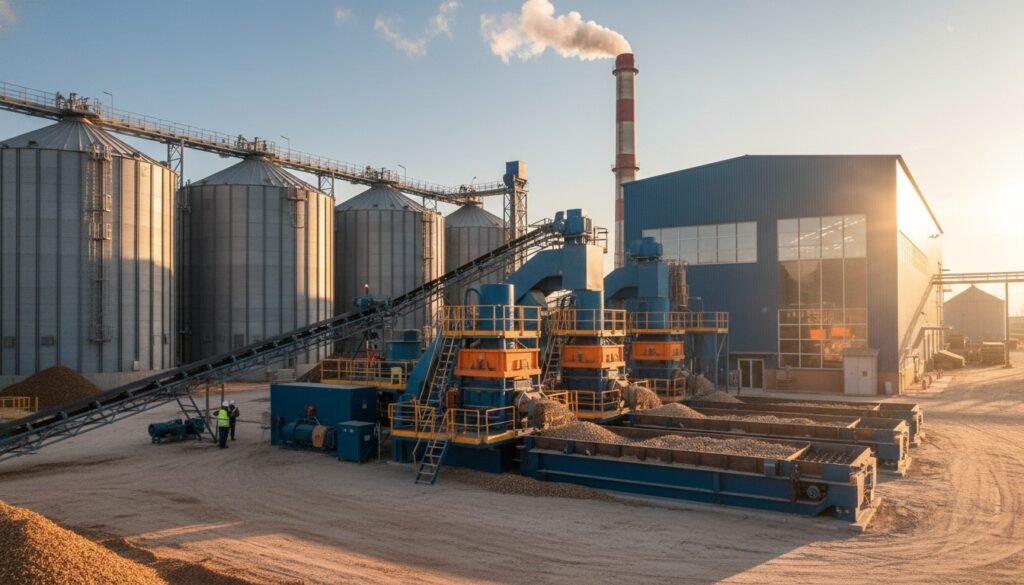
4. The Pelletizing Phase: High-Pressure Extrusion at Wood Pellet Vina Facilities
The pelletizing phase is universally recognized as the heart of the entire biomass manufacturing process. This is the exact moment where loose, finely ground wood meal is miraculously transformed into dense, highly energetic cylinders of renewable fuel. Inside the highly optimized Wood Pellet Vina facilities, advanced ring die pellet mills are deployed to handle this heavy-duty extrusion process. The dried and pulverized wood powder is continuously fed into the center of a rapidly rotating metal ring, known as a die, which is perforated with thousands of precisely engineered cylindrical holes. Inside this ring die, massive stationary steel rollers force the wood material outward, squeezing it through the tiny holes under extreme, immense mechanical pressure.
This phenomenal pressure generates significant friction, which in turn causes the temperature of the wood fibers to spike rapidly, often reaching between 120 to 130 degrees Celsius. This sudden increase in heat is the secret to manufacturing authentic premium wood pellets without the use of any artificial glues or synthetic chemical adhesives. The heat melts the natural lignin—a complex organic polymer found in the cellular walls of the wood. The melted lignin flows through the wood fibers and acts as a highly effective natural glue. As the wood is extruded from the outside of the die, specialized automated knives cleanly slice the compressed biomass to the desired uniform length. Producing a structurally robust pellet that holds together perfectly requires master-level calibration of pressure, moisture, and temperature. As a prominent wood pellet supplier Vietnam, the facility constantly monitors these variables using sophisticated computer-aided systems. It is this unwavering commitment to the precise physics of extrusion that solidifies the reputation of the Best wood pellet supplier, ensuring their biomass fuel is renowned for its smooth, shiny exterior and incredibly high energy density.

5. Cooling and Final Packaging Standards for Wood Pellet Vina Export Products
When the newly formed pellets emerge from the intense pressure of the extrusion die, they are structurally complete but dangerously hot and physically malleable. Because they are held together by molten natural lignin, attempting to package or store them immediately would result in the pellets softening, deforming, and ultimately reverting back into useless wood dust. Therefore, an aggressive and highly controlled cooling phase is mandatory. Inside the Wood Pellet Vina factory, the freshly extruded hot pellets are immediately transported into large counter-flow coolers. In these specialized vertical cooling silos, ambient air is continuously drawn upward through the descending bed of hot pellets. This systematic airflow gently but rapidly lowers the temperature of the biomass to just a few degrees above normal room temperature, successfully solidifying the lignin and permanently hardening the pellets into their final, durable state.
Following the cooling process, the hardened pellets pass over a final vibrating sieve to capture any loose dust or broken fragments—often referred to as ‘fines’—which are then recycled back into the production line to ensure zero waste. The thoroughly cleaned, cooled, and hardened premium wood pellets are now ready for the final packaging and distribution phase. Depending on the specific needs of the consumer, the biomass is either loaded into massive bulk silos for industrial power plant contracts, packaged into heavy-duty one-ton jumbo bags for commercial shipping, or meticulously sealed into smaller, moisture-proof fifteen-kilogram plastic bags for residential heating markets. A top-tier wood pellet supplier Vietnam implements strict quality control checks at this final juncture, testing random samples for durability, moisture content, and ash residue levels prior to dispatch. Ensuring that the product survives complex global logistics without degrading is a hallmark trait of the Best wood pellet supplier, guaranteeing that end-users across the globe receive an impeccably clean, ultra-efficient, and sustainable fuel source ready to power a greener future.
6. Frequently Asked Questions:
1. Question: What exactly are wood pellets made of?
Answer: Wood pellets are exclusively made from highly compressed biomass materials, primarily clean wood residues such as sawdust, wood chips, and shavings sourced from sawmills and forestry operations. No artificial chemicals or synthetic glues are used; the natural lignin inside the wood acts as the binding agent when subjected to extreme heat and pressure.
2. Question: Why is the moisture content of wood pellets so critical?
Answer: Moisture content is the primary factor determining the combustion efficiency of the pellet. If the moisture is too high, the pellets will burn poorly, produce excessive smoke, and yield a significantly lower heat output. High-quality pellets are dried to an optimal moisture level of roughly 8% to 10% to ensure a clean, hot, and highly efficient burn.
3. Question: How do you determine if a manufacturer is a premium supplier?
Answer: A premium supplier meticulously manages every step of the production process, from sourcing clean raw materials devoid of bark and dirt, to utilizing advanced European-standard drying, milling, and pelletizing machinery. They also enforce strict quality control measures to guarantee high energy density, low ash content, and superior mechanical durability.
4. Question: Are wood pellets truly an environmentally friendly energy source?
Answer: Yes, wood pellets are considered a highly sustainable, carbon-neutral energy source. They are primarily manufactured from wood waste that would otherwise decay and release methane. Furthermore, the carbon dioxide emitted during their combustion is roughly equal to the carbon dioxide the tree absorbed during its natural growth cycle, creating a balanced, closed-loop carbon system.
Conclusion:
The production of high-efficiency biomass fuel is a remarkable fusion of natural forestry resources and advanced industrial engineering. As we have explored throughout this detailed operational guide, transforming basic raw wood residues into highly energetic fuel requires a sophisticated, multi-stage manufacturing process. From the rigorous screening and precise thermodynamic drying of the raw materials to the aggressive hammer milling and the high-pressure mechanical extrusion, every single step must be flawlessly executed. It is this unwavering attention to technical detail that defines the operations at the Wood Pellet Vina factory. By consistently maintaining strict oversight over moisture levels, particle consistency, and extreme pelletizing pressures, the facility successfully outputs premium wood pellets that rival any global competitor. Choosing to source energy from the Best wood pellet supplier guarantees access to a clean, reliable, and exceptionally hot-burning fuel that fundamentally lowers greenhouse gas emissions compared to traditional fossil fuels. As a dedicated wood pellet supplier Vietnam, the commitment to environmental sustainability and mechanical excellence is clearly evident in every perfectly compressed pellet that leaves the facility. As global energy demands continue to evolve towards greener alternatives, understanding the science and dedication behind this manufacturing process reassures consumers that biomass is indeed a powerful, viable, and brilliantly engineered solution for our planet’s future energy needs.
Watch more:
YouTube: Wood Pellet Vina
Facebook: Wood Pellet Vina
LinkedIn: Wood Pellet Vina
Website: Wood Pellet Vina
Leave a Reply